The Perfect Pour-Over Starter Kit: Everything You Actually Need
Pour-over looks intimidating from the outside and is gloriously simple once you own five things. Here is the exact kit, and nothing you don't need.
Iris Marchand
June 5, 2026
7 min
Roast Slow is reader-supported. When you buy through links on this page we may earn an affiliate commission, at no additional cost to you. We only recommend gear we would put on our own counter. As an Amazon Associate we earn from qualifying purchases.
Pour-over has an image problem. From the outside it looks like a hobby for people with too much time and too many gadgets — the slow circular pour, the timer, the little gooseneck spout. From the inside it is the simplest, cheapest way to make genuinely excellent coffee, and the whole kit fits on a shelf. Here is exactly what you need, and deliberately nothing you don't.
The dripper
This is the heart of it, and it is almost embarrassingly cheap. The V60 is the standard the whole specialty world brews on — a simple cone with a spiral rib pattern that promotes even extraction. Ceramic holds heat better than plastic, which matters more than beginners expect.
Our picks, compared
Hario V60 Ceramic Pour-Over Dripper
Anyone starting a deliberate pour-over ritual.
Chemex 6-Cup Pour-Over Carafe
Slow weekend mornings and brewing for two.
Fellow Stagg EKG Electric Gooseneck Kettle
Anyone serious about pour-over consistency.
Timemore Black Mirror Basic Coffee Scale
Starting out without spending scale money on a scale.
1Zpresso J-Max Manual Coffee Grinder
The single highest-impact upgrade most home setups can make.
If you are brewing for two and want something that doubles as a serving carafe — and a genuinely beautiful object — the Chemex is the upgrade. Its thicker filters produce an exceptionally clean, bright cup.
The kettle (this is the one that matters)
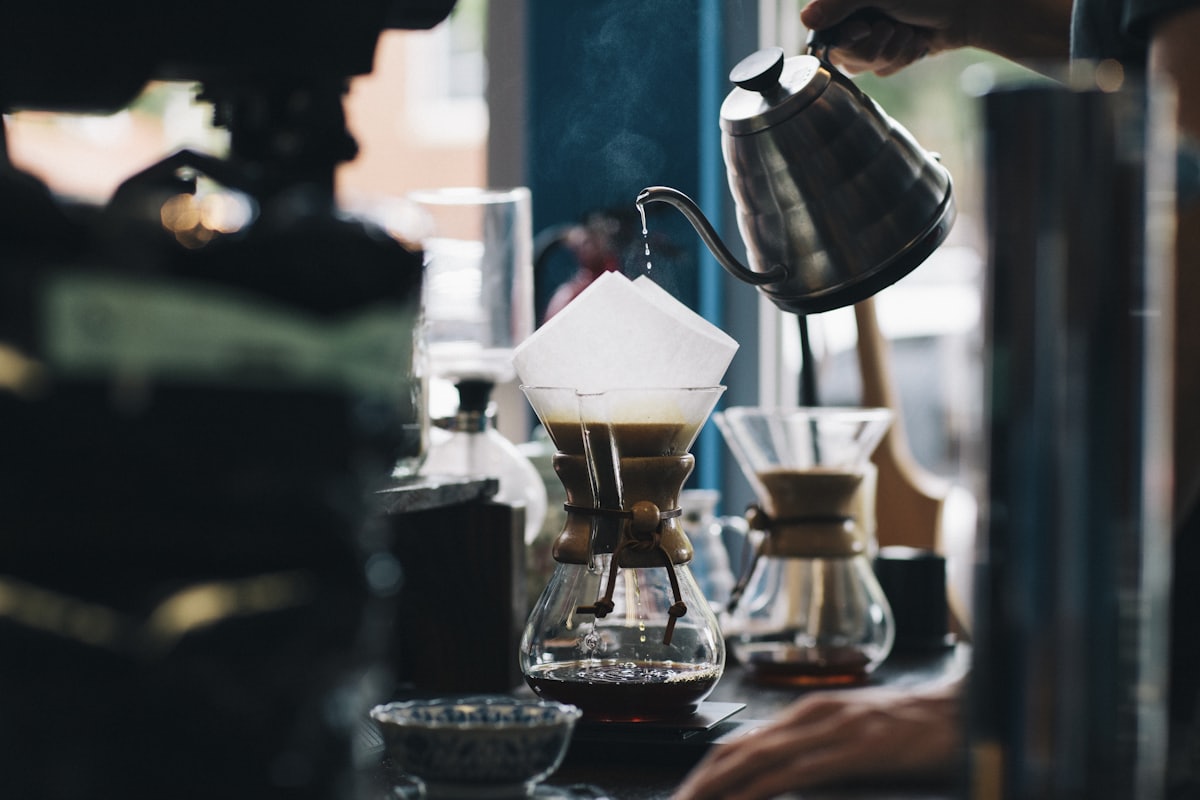
If you spend on one thing here, spend it on the kettle. A gooseneck spout gives you a slow, controlled pour, and temperature control lets you hit the same brew temperature every time. This single tool is the difference between pour-over feeling effortless and feeling fussy.
The scale and the grinder
Pour-over lives and dies on a repeatable ratio. Weigh your coffee and your water, time your brew, and suddenly every cup is consistent. You do not need the expensive scale to start.
And — as always — grind fresh. A consistent grind matters more for pour-over than almost anything else, because the cone shape exposes every flaw in particle size. A hand grinder is plenty for one or two cups.
The ratio that makes it click
Here is the recipe that turns a pile of gear into good coffee: 1 gram of coffee to 16 grams of water. Bloom with twice the coffee's weight in water for forty-five seconds, then pour the rest in slow, steady stages, finishing around the three-and-a-half minute mark. Write down what you did. Adjust one variable at a time. That is the entire craft.
- What do you need for pour-over coffee at home?
- Five things: a dripper (a V60 is the standard), paper filters, a gooseneck kettle for a controlled pour, a scale to weigh coffee and water, and a burr grinder for a consistent fresh grind. A separate carafe like a Chemex is optional and doubles as the dripper.
- Is a gooseneck kettle necessary for pour-over?
- It is the most worthwhile upgrade. A gooseneck spout gives you the slow, controlled pour that even extraction depends on, and temperature control lets you brew at the same temperature every time. You can start with any kettle, but the gooseneck is what makes pour-over feel effortless.
- What is the best coffee-to-water ratio for pour-over?
- Start at 1:16 — one gram of coffee for every sixteen grams of water (for example, 20 g coffee to 320 g water). Bloom with about twice the coffee's weight in water for 45 seconds, then pour the rest in stages. Adjust to taste from there, one variable at a time.
Iris Marchand
Iris is a former hospitality writer who quit her job to apprentice at a roastery in Lisbon. She has been writing about specialty coffee since 2018.